Blunt force-security threat: What is blunt force, and what type of injuries result from blunt force impact?
Thank you for reading this post, don't forget to subscribe!
Severe injuries and deaths resulting from blunt force trauma are some of the most common cases encountered by forensic pathologists. For instance, many transportation fatalities, including those involving road traffic collisions and pedestrians being hit by vehicles, result from blunt force trauma.
Blunt force trauma is also the consequence faced by homeland and private security professionals after being hit by a solid object, such as a fist, iron bar, bottle or furniture item, to name but a few, or after being pushed against another solid object or down a flight of stairs.
Blunt abdominal trauma (BAT) comprises up to 75% of all blunt trauma and is the most common example of this injury.
The severity of blunt force injuries is mostly determined by the speed, velocity, size and weight of the object involved and can range in severity from a tiny bruise to internal hemorrhages, bone fractures, cardiac tamponade, airway obstructions/rupture and, in the worst-case scenario, ruptured organs, rapid internal bleeding or death.
I do believe most security professionals will be aware of the potential severity of injuries resulting from blunt force. But I also believe that blunt force injuries are underreported and underdocumented by security professionals in general.
Security leaders can provide frontline security teams with tools, such as body armour, to help mitigate the damages from blunt force-security threat incidents. However, it is worth noting that any type of flexible body armour made from either an aramid fibre (i.e. Kevlar) or a polyethene (i.e. Dyneema) doesn’t necessarily give 100% protection against the specific operational risk of blunt force trauma.
On a domestic level (meaning homeland or private security, rather than military), the risk of security guards or officers being punched, beaten or kicked is higher than being stabbed or shot. When choosing body armour to protect from blunt force injuries, the key objective must be to offer sufficient levels of protection from the most realistic threats and risks security teams face while on duty.
Security leaders must consider several important criteria when investing in body armour, such as concealability, weight, thickness or the level of protection from the risks and threats identified by the organization. Specific features needed will vary from one organization to the next based on a number of factors.
If the concealability of body armour is key, for example during covert operations and surveillance, then thickness may be the most important consideration and blunt force trauma protection may have to become of secondary importance.
To achieve the maximum level of protection from blunt force trauma injuries, body armour has to be of a rigid structure, rather than a soft/flexible structure. Two diverse protective devices highlight the importance and effectiveness of such protection:
-
Blunt Force – Security Threat and Motorbike Helmets:
Wearing a helmet during a motorcycle crash significantly reduces the risk of damage to one’s skull, traumatic brain injury and even death. Motorbike helmets have a rigid structure — they would not offer blunt force protection and perform to the level required if the structure was soft or flexible.
-
Blunt Force – Security threat and Riot Shields:
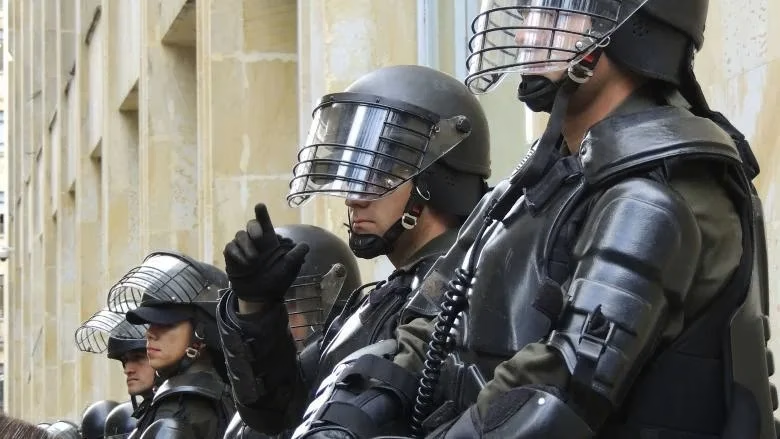
A riot shield is a lightweight protection device typically used by police during riots, protests and mass disturbances. They are often constructed from a rigid material to offer maximum protection from attacks with blunt weapons and thrown projectiles. Again, to offer this high level of blunt force protection, it is required for its structure to be rigid, not soft or flexible.
The most in-depth research study on blunt force-security threat and trauma injuries or, in more tactical terms, ‘backface signature injuries’ sustained while wearing such body armour, was produced by Marianne Wilhelm back in 2008 and is titled “Injuries to law enforcement officers: The backface signature injury.”
This piece has raised important questions regarding the protection afforded to officers wearing personal body armour, along with the current test methods used to assess the true performance of the equipment. Some test results revealed deformations exceeding the National Institute of Justice (NIJ) standard’s backface signature limit. Such increased deformation can lead to serious injuries, including blunt force trauma or backface signature injuries, which have occurred in the field over and over again.
Although some body armour might be successful in containing a round fired by a weapon or the thrust of a knife, it might not provide the same protection from the impacting energy during other types of assault, such as punching, kicking or more. One standard for body armour in relation to blunt force trauma protection is the Association of Test Laboratories for Bullet-Resistant Materials and Constructions (VPAM) study, titled: “Testing of Impact Resistance against Throwing and/or Striking Objects.”
Does your organization’s body armour provide protection against shots, knives, spikes, needles and blunt force-security threats and trauma? It’s worth researching the answer to that question.
Author – Robert Kaiser