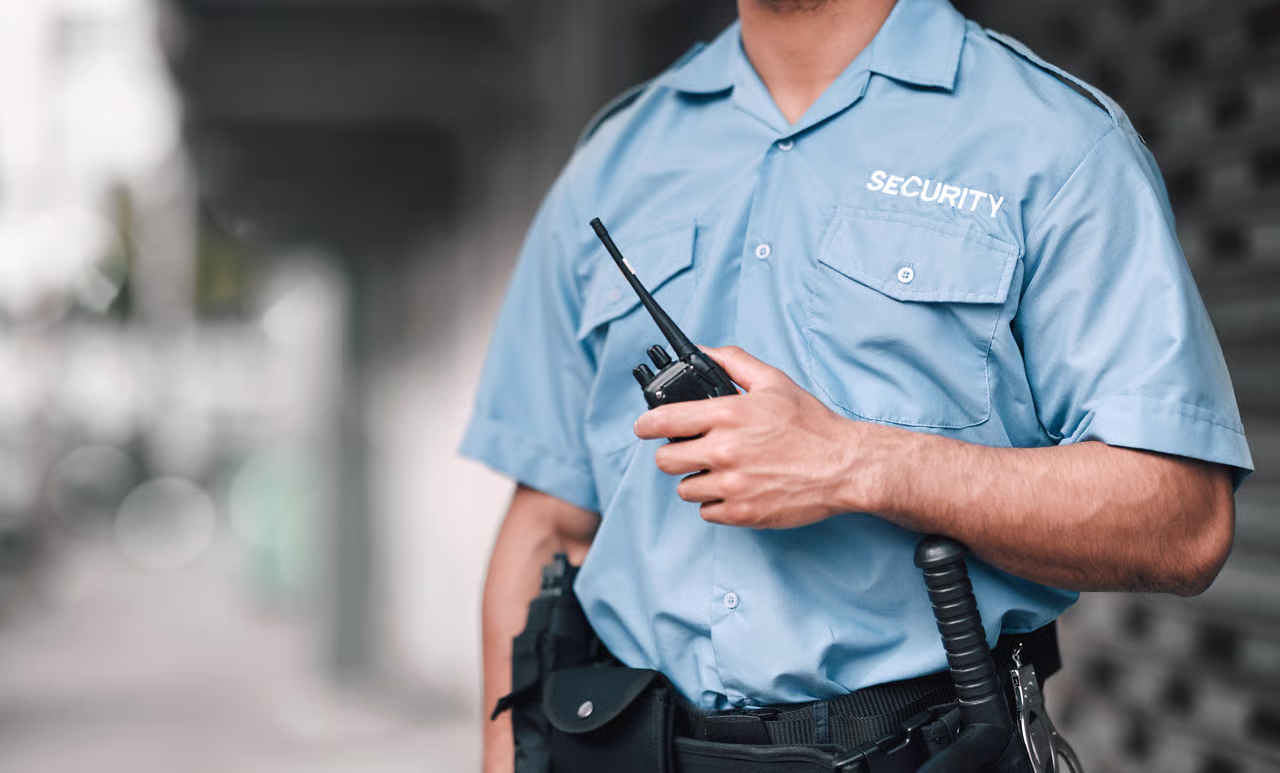

Strengthening retail security to combat new threats: Retail security leaders face an evolving landscape of threats as bad actors appear to be more brazen, even when met with increased security presence and enhanced video quality.
Thank you for reading this post, don't forget to subscribe!
Companies are experiencing different types of attacks with new patterns. Organized retail crime (ORC) perpetrators are well-organized and timed, and they execute attacks with intention. Mobs rush in and can overwhelm store staff and security. Smash and grabs and catalytic converter thefts continue to be big concerns for patrons and put their safety at risk.
Given recent technology advancements and deepening knowledge of how to address security concerns, retail security leaders must adapt their playbooks to stay ahead in 2024.
3 trends shaping retail security strategies
Despite the shifting ORC tactics, there are still proven ways to anticipate a potential incident.
Security technology is effective at identifying these patterns, and it is shifting from evidence-gathering to providing actionable insights. With technology, staff are more empowered to respond proactively and precisely.
As retailers assess ways to strengthen their security strategies with these facts in mind, the following three industry trends can guide them to mitigate their risks:
- Loitering analytics will get more dependable and predictable. By coupling video surveillance solutions with generative artificial intelligence (AI), patterns around loitering and loitering analytics can enable contextual analysis. The idea is to tell what is happening presently give context based on the past and possibly give statistical insights to direct the future. Covering all areas of a store with video monitoring solutions — being mindful of the distance to a target and width of the scene — and investing in solutions with predictive analytics capabilities are essential for informing security strategies.
- Composable security solutions will deliver tangible benefits. More and more “as a service” solutions (i.e. video surveillance as a service/VSaaS) will pop up to consolidate vendors, screens and solutions. With that said, security professionals will demand composability. Security systems can no longer work in silos. Each technology or tool needs to communicate and direct actions to other systems. For example, a cartwheel locking system should communicate with a mobile surveillance unit (MSU) in the parking lot, and that MSU should communicate with a gate and lighting system. Security system composability will need to be built around open, industry-standard communications, and we can expect regulations will come to ensure data accountability for owners of centralized systems.
- Security will need to balance with convenience. When bad actors take advantage of convenient plays, security will encroach on convenience out of necessity. This theme will gain steam and a lot of the normal conveniences, like reading the back of a medicine box, will be taken away to secure areas. The same can be said for parking lots and drive-throughs. Anywhere being preyed on by bad actors because they are “convenient” targets is a prime area to rebalance convenience with security protocols. Controlling inflows and outflows to parking lots along with the overall daily flow of traffic, for example, will become more commonplace to harden environments against bad actors.
When assessing potential retail security investments, leaders should prioritize solutions that reduce response time and coordinate responses across all areas. Any technology that increases response time for any reason is ripe for replacement. Further, prioritize vendors that allow low- to no-cost proof of concepts. Verify, not trust, holds when proving security solutions.
Making the most of retail security investments
Coupling human capital with intelligent technology will help retailers protect every vulnerable area of their environment. Technology empowers security staff to respond in real time, and evidence and metadata that is gathered by more advanced video management systems will keep adding to security leaders’ ability to shift from reactive to proactive loss prevention and crime deterrence strategies.
Author – Dave Baker